Health - actual costs to date
There are two areas that need to be reviewed when assessing the health of actual costs to date:
- Cost reconciliation to accounting system.
- Strategy tasks correctly coded.
Costs reconcile to accounting system
It is important to ensure that the actual costs in AMT balance to the costs recorded in the accounting system. The accounting reconciliation is typically done on a monthly basis. Site management should ensure that this reconciliation is being performed, and any reconciling items are corrected.
Strategy tasks correctly coded
If a strategy task is incorrectly coded, AMT does not recognise that it has been performed and will allocate the costs to "unassigned". This will both distort the analyses of the actual cost variance and cause the future projections to be inaccurate.
There are three key indicators that highlight incorrect coding:
- High actual cost variance in unassigned.
- % of totals costs in unassigned.
- Overdue components.
Each of these are explained below.
High actual cost variance in unassigned
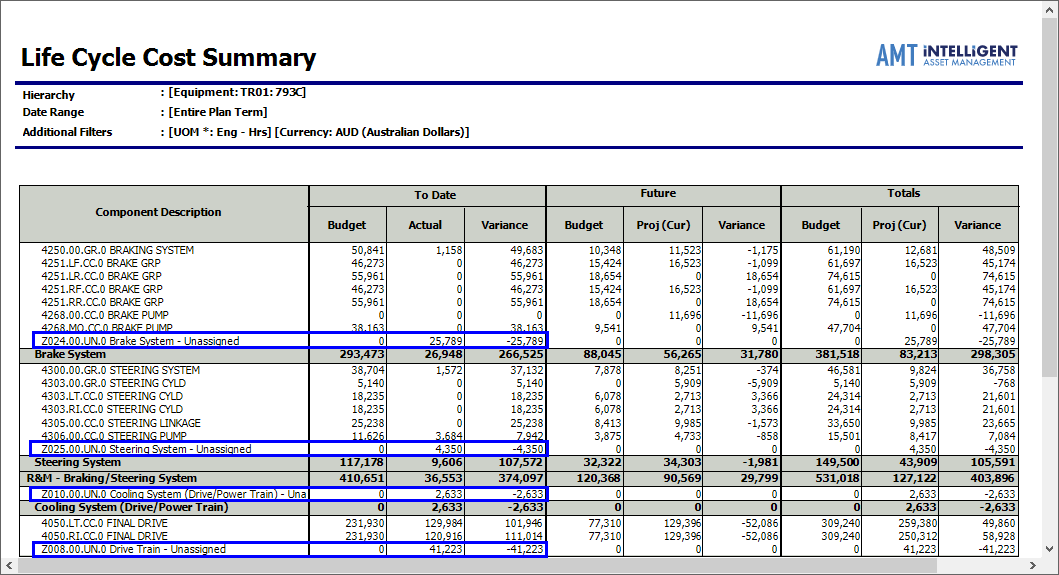
The example report below highlights costs that should have been allocated to a strategy task that have in fact gone to unassigned.
% of Total costs in Unassigned
The target is for not more than 15% of total costs to be put in unassigned. It is very poor if more than 25% of total costs are in unassigned.
To calculate the percentage of total costs in unassigned you need to run the Cost Analysis - To date report and analyse by task type. Do this for each fleet.
Overdue components
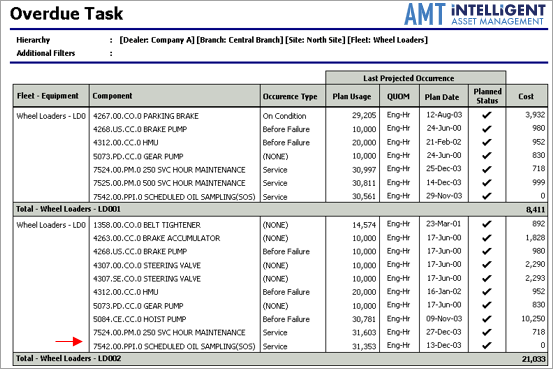
The overdue components have in fact been performed but not recognised by AMT.
The overdue percentage is calculated as the number of overdue tasks versus all strategy items which have a planning task type.
To correct incorrect coding, open the Work Order Settlement Manager, and use the filters to identify the specific work orders. Double-click on any specific work order to edit the coding. You can also use Work Order Settlement Manager to identify incorrect coding. Filter for high value non-strategy items and vice versa.
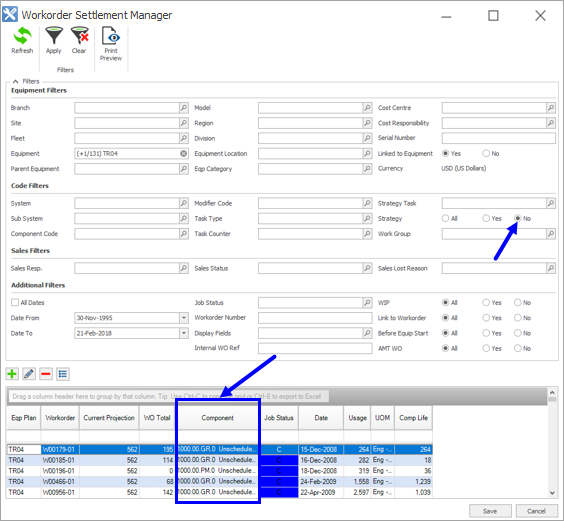
In the example screenshot above, many of the work orders listed are probably strategy tasks that had incorrect modifier codes.